 Uno Blueprint
Get your human and AI teammates on the same page.
An open-source toolkit for context engineering: a canvas for your team, a harness for your agents.

Your context is everywhere. Your agents need a map.
MCP connects your agents to your tools. Uno Blueprint shows them how it all fits together, so they find the right context the first time.
Your product knowledge is spread across PRDs, designs, code, dashboards, and threads.
Uno map, duo users
Your team works on a visual canvas. Your agents query the same blueprint as structured data.
Built for RAG
Agents search every step by meaning, then pull only the ones a question needs.
Scalable structure
Map one focused journey for a small project, or every service in a large organization.
Product context, built in
Each step carries what your team tracks: owner, status, value, and dependencies.
Sources stay attached
Every step links to its sources, so anyone can trace it back to the PRD, design, or thread behind it.
Canvas for your team.
See how your whole service works, keep it accurate together, weigh one path against another, and tailor it for every stakeholder.
Get up to speed. New to the service? See it end to end, then open any step for the detail.
Harness for your agents.
Four skills teach your agents to build the map from your docs, keep it accurate, and test changes against it.
drops off the device
call with a quote
logs the devicetags it
diagnoses the fault
parts inventory
Map. Point it at your docs. It works out the lanes and steps, places what it finds, and holds the draft until you sign off.
One blueprint.Every place you work.
Open it in the app or on your phone, call it from your coding agent, or bring it into team chat. It plugs into the way your team already works.
In the app. Ask the built-in agent and watch it point at the blueprint. Bring your own model key.
Same agent, same sources.Better answers with a map.
On a real service, the map more than doubled accuracy and cut what agents read by a third.
Ideas we build on.
Uno Blueprint sits where service design meets context and harness engineering.
A blueprint is more precise than verbal definitions and less subject to misinterpretation.
(opens in a new tab)2013Service designLavrans Løvlie, Andy Polaine and Ben ReasonService Design: From Insight to ImplementationIt is because many services are almost invisible that nobody takes care to design them.
(opens in a new tab)2017Service designSarah GibbonsDesign executive, formerly Nielsen Norman GroupBlueprints are treasure maps that help businesses discover weaknesses.
(opens in a new tab)Jun 2025Context engineeringTobi LütkeCEO, Shopify
I really like the term “context engineering” over prompt engineering. It describes the core skill better: the art of providing all the context for the task to be plausibly solvable by the LLM.
(opens in a new tab)Jun 2025Context engineeringPhilipp SchmidAI Developer Experience, Google DeepMindMost agent failures are not model failures anymore, they are context failures.
(opens in a new tab)Feb 2026Harness engineeringRyan LopopoloPrincipal Engineer, Google CloudOne of the earliest lessons we learned was simple: give Codex a map, not a 1,000-page instruction manual.
(opens in a new tab)Feb 2026Harness engineeringMitchell HashimotoCo-founder, HashiCorpIt is the idea that anytime you find an agent makes a mistake, you take the time to engineer a solution such that the agent never makes that mistake again.
(opens in a new tab)Apr 2026Context engineeringAndrej KarpathyCo-founder, OpenAIThe human's job is to curate sources, direct the analysis, ask good questions, and think about what it all means. The LLM's job is everything else.
(opens in a new tab)Apr 2026Harness engineeringBirgitta BöckelerPrincipal Engineer, UnblockedA good harness should not necessarily aim to fully eliminate human input, but to direct it to where our input is most important.
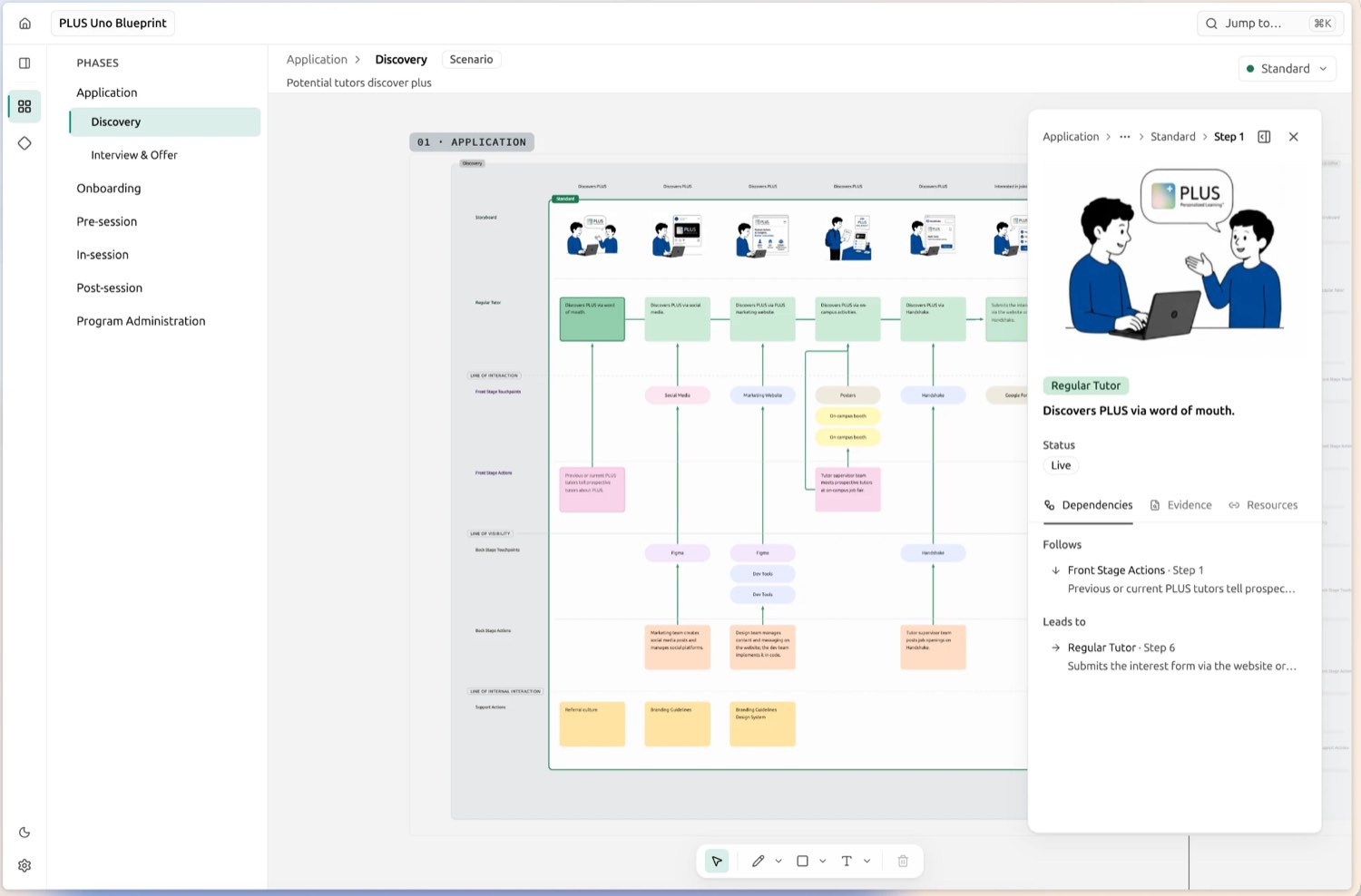
(opens in a new tab) PLUS
PLUS Uno Blueprint
A tutoring program on one blueprint, from a tutor's application to the session and after.
Free and open source.Uno command to start.
Start with a working template and sample data, then map your own service.
Database
Your blueprint lives in your own database. Pick your host and paste the prompt into your agent.
Connect this Uno Blueprint workspace to a Supabase project, following SETUP.md from step 3. I will create the project and give you its URL and anon key. Keep every key and connection string in .env, never in a tracked file. Link the project, push the migrations, and load the seed, then run npm run check:target and show me the schema version it reports.
Skills
Add the skills to the coding agent you already use.
claude plugin marketplace add BilLogic/uno-blueprintclaude plugin install ub@ub-marketplaceInstalls the four skills as slash commands, in any project.
/ub:mapDraft a blueprint from your docs./ub:sliceCut a view for one audience./ub:auditList gaps, conflicts, and stale sources./ub:whatifTrace a change before you make it.
Prompts
Describe what you want, and let your coding agent do the work.
Map a service from your docs
Read the docs in this folder and draft a blueprint of how we handle repair intake. List what you couldn't find.
Gut-check an idea
Could users approve quotes by text instead of a call? Say what the blueprint covers and what it doesn't.
Scope a change
What breaks if users book online instead of walking in? Don't change anything yet.
Find what's missing
Audit the repair intake blueprint and list steps with no owner, conflicts, and stale sources.
Uno more thing.
Uno means one. One map of the service, for people and agents both.
MCP lets an agent reach your tools. Uno Blueprint gives it a map of what lives in them and how it fits together. It works on top of MCP, not instead of it.
One map of how a service runs: each step your user takes, what the team and systems do behind it, and who owns each part.
No. Tools such as TheyDo, Smaply, Cemantica, and JourneyTrack manage customer journeys across a portfolio. Uno Blueprint maps how your services run, from what the customer sees to the work behind it, for your team and your agents. It's open source, so you can shape it to fit your team, and it can sit beside the tool you already use.
No. Your docs stay in their tools. The blueprint organizes what they hold and links back.
Yes. Hand your agent a FigJam, Figma, or Miro board, or a spreadsheet. It translates it into a blueprint for you to check and sign off.
No. The code is open source; your blueprint lives in your own database.
No. Agents draft, check, and suggest. Drafts need sign-off, and every edit can be undone.
The agent built into the app, and coding agents such as Claude Code, Cursor, and Codex, which run the four skills. Any one of them is enough, and any agent can read a published blueprint.